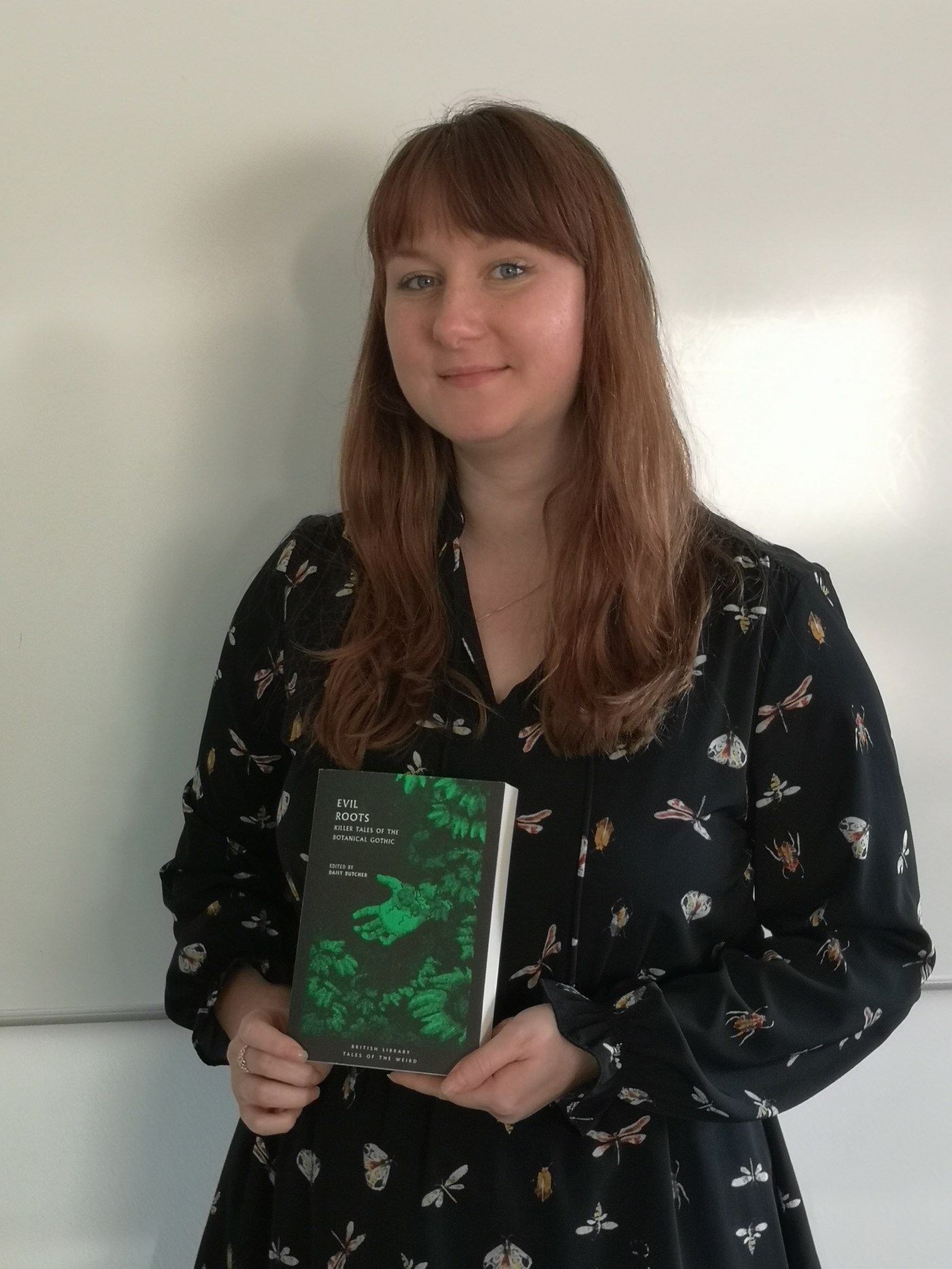
University of Hertfordshire PhD student Daisy Butcher has collected a series of short stories for the release of her first anthology, Evil Roots: Tales of the Botanical Gothic, with the British Library.
The anthology, which is apart the British Library’s Tales of the Weird series, was published because Daisy thought: “They don’t have one on killer plants. So, I thought I’ll reach out to them and ask them if they’d be interested in one because there wasn’t anything like they’re out there at the time. [The anthology] follows the history and literacy of killer plants in gothic fiction from the 19th to early 20th century.”
Daisy first became interested in the killer plant genre as an undergraduate, when she did a gothic fiction module during her second year, as she remembers “thinking oh wow we can talk about these things and we can study these things that’s so cool. So, I just found it really interesting to sort of dissect horror and gothic and monsters and what that says about society. So, I just got hooked ever since”.
It appears killer plants are not strangers, when it comes to gothic fiction; according to Daisy: “They’ve been around for a long time, maybe even longer than a lot of other monsters we know and that are probably more famous. Like for instance, the first short story [has] a killer plant monster which is a poison ivy plant sort of woman [like DC comic character Poison Ivy], and it’s a good fifty years before Dracula, and just thinking about that and it’s quite mad.”
A lack of scholarly sources about killer plants to cite in her PhD, is what Daisy decide to publish the anthology. She hopes the anthology will help introduce people to killer plants, as she feels “they’re really underrepresented and deserve their own genre.” in gothic fiction. “I wanted to show how it was a gothic phenomenon and also the lead up to science fiction. I got some nice stories from female authors in here as well, which I was really pleased to include. But I had to be careful not to choose any stories that might have potentially any racist language or
imperial undertones, which was common at the time”, reflects Daisy.
Evil Roots contains 14 stories about Killer Plants from various authors, Daisy noted Carneverine by Lucy H Hooper as one of her favourites, due to its references about Darwinism. Daisy explained how “[Darwin] also wrote scientific treaties on plants and started the killer plant movement in a way, because he wrote on carnivorous plants. And he [even] did an experiment where he fed one meat. [The story] involves a botanist who experiments on a carnivorous plant, he starts to give it meat and watch it become quite monstrous”.
“He has a really interesting theory that this botanist in the story believes that carnivorous plants evolve or devolved from dragons. And I just loved that, it’s just so unusual and stood out for me”, revealed Daisy.
The Evil Roots anthology concludes with ‘The Moaning Lilly’ by Emma Vane. Daisy said “[the story] is unique in its body horror elements due to its lurid, feminine and erotic descptions of the flower’s mouth. Emma Vane’s story blurs the lines between human, plant and predatory prey”.
It’s notable that the classic 80’s musical ‘Little Shop of Horrors’, directed by Frank Oz, (which Daisy used to launch her book at the Odyssey Cinema in St Albans) presents itself as a more comedic version of ‘The Moaning Lilly’; which is its predecessor by almost fifty years.
“[Little Shop of Horrors] is an interesting parallel in turns of a blood drinking killer plant, and this like idea of this obsession of the botanist and his specimen and how far they will go for this specimen to survive, so it can bring them fame and fortune”, comments Daisy.
However, Daisy notes the importance of distinguishing the comedic plants of the film, and the gothic plants in her book: “I think it’s really important and really interesting to look at these older stories and that they’re aren’t sometimes these comedic monsters”, she said. “They can be quite gothic and scary, and they can represent a metaphor in terms of man vs. nature”, which is the main message that Daisy has communicated throughout her anthology and her PhD research.
The next chapter in Daisy Butcher’s PhD will, of course, be about killer plants, where she plans to cite her own anthology. “The timing [of the anthology] is fantastic. So, I’ll get to cite myself in my own PhD, which is amazing and not something you get to do every day”.
 the girl and the city of books
Leave a comment